PRESS RELEASE
May 21, 2026
Health network lauds DOH, NNC for breakthrough Philippine Nutrient Profile Model
Championing its public health advocacy to prevent of noncommunicable diseases (NCDs), the Healthy Philippines Alliance (HPA), a civil society network convened by HealthJustice, applauded and expressed full support for the provisionally approved Philippine Nutrient Profile Model (PNPM) established by the National Nutrition Council (NNC) and the Department of Health (DOH).
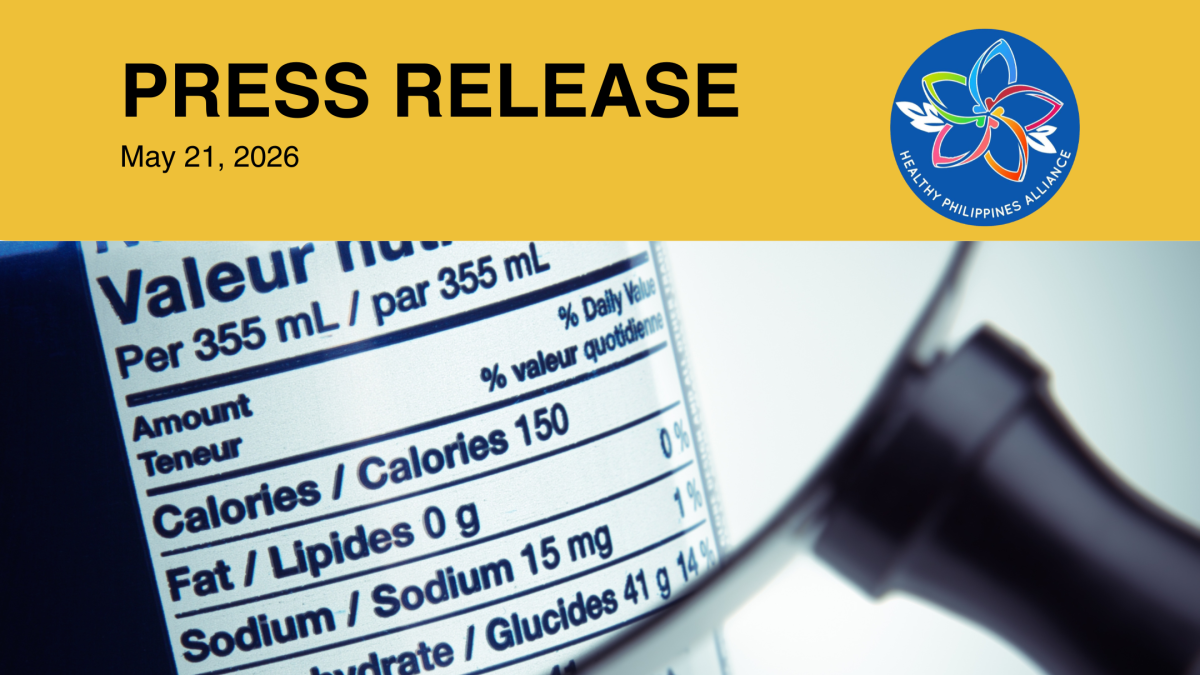
The PNPM, after undergoing rigorous scrutiny and multiple revisions since 2019, sets the baseline for levels of sugar, sodium, and saturated fats in packaged processed and ultra-processed food products, hence easily classifies as unhealthy those that exceed the thresholds.
“We congratulate the NNC and DOH for establishing this game-changing nutrition policy tool. While but one step, this will make a transformative impact on improving the nutrition standards and food environment in the Philippines. We look forward to the immediate application of the tool to regulatory policies such as front-of-pack warning labels, healthy food procurement of government agencies, and unhealthy food taxes. Hopefully, this leads Filipinos, especially children, to better food choices and diets that help them avoid NCDs like hypertension, heart disease, and diabetes,” said Dr. Jaime Galvez Tan, former Health Secretary and lead convener of the HPA.
HPA member, Dialysis-PH Support Group, is optimistic that the PNPM can help shift the tide of rising chronic kidney disease (CKD) and dialysis patients.
“The PNPM, when applied in nutrition policies like front-of-pack food warning labels, takes the guesswork out of the grocery aisle. We believe this can be life-saving for Filipinos, especially young people, who need access to healthier and nutritious food products. This has the potential to reshape our food environment, driving manufacturers to reformulate products to meet critical sugar, sodium, and fat thresholds. Because to us, dietary intervention is our first line of defense against CKD so individuals can precisely manage their nutrient intake before permanent kidney health damage occurs,” Dialysis-PH Founder Reynaldo Abacan, Jr. said.
The HPA further urged NNC and DOH to approve the nutrition policy tool with finality and improve it in real-time upon rollout.
Dr. Galvez Tan added, “The most ideal PNPM we have always advocated is one designed to unilaterally apply to all processed and ultra-processed food, similar to the World Health Organization-Pan American Health Organization (WHO-PAHO) model. It is the easiest to implement and detects the widest range of unhealthy products. Nonetheless, we are equally satisfied that the current PNPM is strict in itself, while more complex by dividing food into several categories such as milk products, pastries, cereals, and so on.”
The field testing research completed by the University of the Philippines Manila, College of Public Health (UP-CPH) this year reinforces this comparison. Several NPMs used by other countries, including the WHO-PAHO model and the current PNPM, were tested and applied to about 5,000 locally available packaged products.
Dr. Kim Leonard Dela Luna, Chairperson of the Department of Nutrition of the UP-CPH explained, “Our findings show that the WHO-PAHO model is still the best at profiling and capturing the most packaged products that exceed the levels of sugar, sodium, and fats. But the current PNPM works almost at par while designed to be food category-specific. We highly recommend our government implementing agencies to be transparent and free from conflicts of interest, and to make sure that all products are accurately and clearly categorized.”
The PNPM as a policy tool is a crucial reference to implementing several health and nutrition policies like front-of-pack food warning labels, marketing restrictions for unhealthy food, unhealthy food taxation, and food procurement by government in schools, workplaces and during calamities.
END