Policy Brief – Addressing Noncommunicable Diseases through a National Front-of-Pack Labeling (FOPL) Policy in the Philippines
June 21, 2024
Public health advocates welcome PAHO Nutrient Profile Model to be adopted in PH
August 1, 2024
The Healthy Philippines Alliance (HPA), a coalition of civil society organizations fighting to prevent noncommunicable diseases (NCDs), is one with majority of the Filipino people who support adopting front-of-pack warning labels (FOPWL), or simply put, food warning labels for the country, backed-up by results of a nationwide survey by the Social Weather Stations (SWS).
The SWS survey was commissioned by the HPA for the 1st Quarter of 2024 to find out public perception of food warning labels in the Philippines. The results established our citizens’ strong support for the implementation of food warning labels on packaged food and beverage products and manifested their interest to protect consumer health. This comes in time for the celebration of Nutrition Month this July with the theme, “Sa PPAN: Sama-sama sa Nutrisyong Sapat Para sa Lahat!”, highlighting the national nutrition framework.
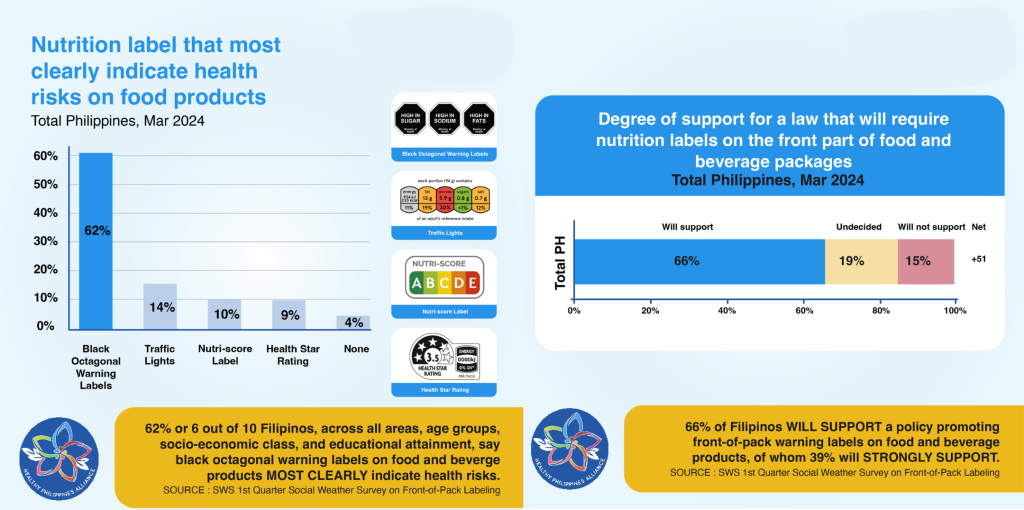
In detail, 66% of Filipinos said they will support a policy that will implement food warning labels for pre-packaged and ultra-processed food and beverage products, of whom 39% will strongly support. Moreover, 62% or 6 out of 10 Filipinos, across all demographics, areas, socio-economic and educational status, said that food warning labels (black octagonal warning labels scheme) are the most effective at communicating health risks versus other labeling schemes, specifically the Nutri-score, Health Star Rating, and Traffic Light. Food warning labels or the black octagonal warning labels directly identify which products have high or excessive amounts of sodium, sugar and saturated fats that can be harmful to health.
“The SWS survey demonstrates that adopting a food warning labeling policy can effectively protect consumers against unhealthy food and drinks. More importantly, the Alliance appreciates that the Department of Health (DOH) and the National Nutrition Council (NNC) have similarly identified front-of-package labeling as a priority policy initiative for the prevention of NCDs and we express full support to move this forward,” said Dr. Jaime Galvez Tan, convenor of the HPA and Board Member of HealthJustice.
The HPA explained that an unhealthy diet and improper nutrition is a risk factor to developing NCDs like cancer, diabetes, heart and kidney disease. Sadly, our food environment has been saturated by pre-packaged ultra-processed foods (UPFs). UPFs, more commonly known as junk food, are industrially formulated products with preservatives, artificial additives and are typically high in critical nutrients such as sugar, sodium, and fats. UPFs are linked to obesity, hypertension, and NCDs. In the Philippines, 70% of all deaths are attributed to NCDs, the HPA emphasized.
“There is mounting evidence that food warning labels are a powerful tool to influence consumer attitudes to avoid unhealthy food and to develop a preference for natural and minimally processed foods to protect health. It has encouraged the reformulation of food and beverage products that will lessen the amounts of sugar, sodium, and fats. This has helped improve the unbalanced food environment for people, especially children,” added Dr. Galvez Tan.
He continued, “Other countries have taken action to protect their people from ultra-processed foods. Unfortunately, the Philippines has lagged behind in this area. So, it is high time that the DOH takes the lead in pushing for food warning labels as a strategy to arrest the rising cases of diet-related NCDs in the country.”
Food warning labels have been pioneered by Chile in 2016, after which other Latin American countries like Mexico, Argentina, Peru, Colombia, Uruguay, and Venezuela adopted and improved the policy.
The “HIGH/EXCESSIVE” food warning labels are straightforward, easily eye-catching, quickly understood, and thus, have performed the best at decreasing consumers’ intent to purchase products with excessive amounts of critical nutrients, according to the Pan American Health Organization (PAHO) in 2020.
More importantly, food labeling policies “have the potential to reduce the prevalence and incidence of a range of NCDs, by as much as 5%,” based on UNICEF’s Policy Brief in 2020.
Contact Person :
Patricia Loren M. Reyes
Communications Officer
HealthJustice
Healthy Philippines Alliance
+639760085498
plamangune@gmail.com
healthjustice.ph
phealthalliance.ph